
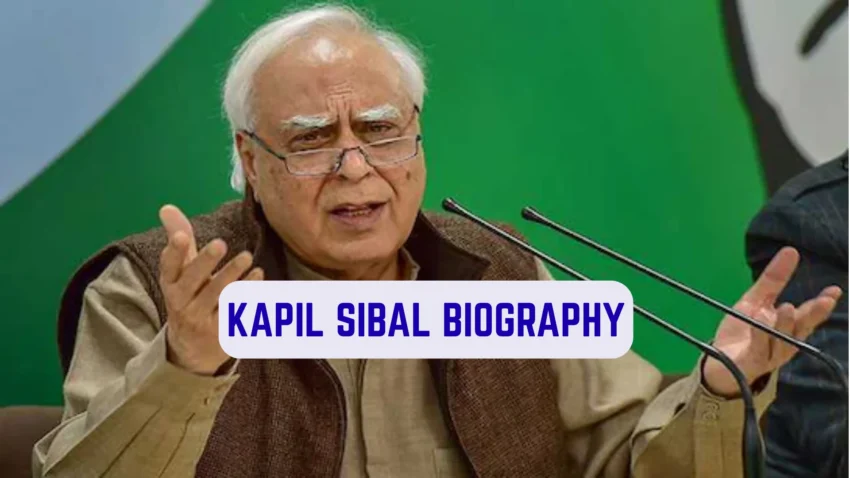
Kapil Sibal is one of India’s most distinguished lawyers, influential politicians, and thought leaders whose work has shaped modern legal and educational reforms in the country.
Known for his impressive legal acumen, eloquence, and drive for public service, Sibal has served in multiple ministerial portfolios and contributed to key national policies in India.
Early Life
Born on 8 August 1948 in Jalandhar, in the northern Indian state of Punjab, Kapil Sibal grew up in a family deeply rooted in law and public service. His father, Hira Lal Sibal, was a renowned lawyer who received the prestigious Padma Bhushan and was celebrated as a “Living Legend of Law.”
Kapil’s early upbringing was marked by intellectual stimulation and encouragement toward education and justice. The family migrated to India after the partition in 1947, settling in Chandigarh, where Kapil completed his schooling at St. John’s High School.
Education
Kapil Sibal’s academic journey reflects his commitment to excellence:
- Bachelor of Arts and Master of Arts in History from St. Stephen’s College, University of Delhi.
- LL.B. (Bachelor of Laws) from the Faculty of Law, University of Delhi.
- LL.M. (Master of Laws) from the prestigious Harvard Law School, completed in 1977.
Despite being offered a position in the Indian Administrative Service in 1973, Sibal chose to pursue his passion for law and established his own legal practice.
Legal Career and Achievements
Sibal quickly gained recognition for his sharp legal mind. He was designated a Senior Advocate in 1983 and served as Additional Solicitor General of India from 1989 to 1990.
Throughout the 1990s and early 2000s, he represented high-profile cases in the Supreme Court of India, including defending judges in impeachment proceedings — a rare and notable accomplishment.
He also served as the President of the Supreme Court Bar Association multiple times, cementing his reputation as one of India’s foremost legal minds.
Transition to Politics
Kapil Sibal’s transition into politics came through the Indian National Congress party. In 1998, he was nominated to the Rajya Sabha (Upper House of Parliament) representing Bihar.
He later entered the Lok Sabha (Lower House) by winning the Chandni Chowk constituency in Delhi during the 2004 general elections and retained his seat in 2009.
Ministerial Roles in Government
During his tenure in the United Progressive Alliance (UPA) government led by Prime Minister Dr. Manmohan Singh, Kapil Sibal held several important portfolios:
- Minister of Science and Technology
- Minister of Earth Sciences
- Minister of Human Resource Development
- Minister of Communications and Information Technology
- Minister of Law and Justice
One of his most impactful contributions was championing the Right of Children to Free and Compulsory Education Act (RTE), which ensured that every child between the ages of 6 and 14 in India has access to free elementary education.
Reforms and Policy Contributions
Sibal’s ministerial tenure brought significant policy reforms:
- Revamping education policies and evaluation systems.
- Introducing digital initiatives to enhance IT and communication infrastructure.
- Pushing forward legal reforms to modernize frameworks for internet and communications laws.
Beyond politics, he has been a vocal advocate for youth education, innovation, and inclusive policies that balance growth with legal safeguards.
Personal Life
Kapil Sibal has balanced his professional life with personal pursuits. He has published collections of poetry — including I Witness — showcasing his creative side beyond law and politics.
He married Nina Sibal in 1973, who sadly passed away in 2000, and later married Promila Sibal. He has two sons, both of whom are lawyers by profession.
Legacy and Influence
Kapil Sibal’s journey from a gifted student to a senior lawyer and respected politician highlights his deep commitment to public service. His legal contributions and policy initiatives have left a lasting impact on India’s legal system, educational frameworks, and political landscape.
Frequently Asked Questions (FAQs)
1. Who is Kapil Sibal?
Kapil Sibal is a senior Indian lawyer and politician who has served in key ministerial roles in India’s government and is known for his legal expertise and policy reforms.
2. What are Kapil Sibal’s major contributions?
He played a leading role in educational reforms, law and justice policies, tech and communications growth, and ensuring free compulsory education for children.
3. Where did Kapil Sibal study law?
He earned his LL.B. from the University of Delhi and an LL.M. from Harvard Law School.
4. What is the Right to Education Act?
It’s a law that mandates free and compulsory education for all children aged 6 to 14 in India — championed by Sibal during his ministerial tenure.
5. Is Kapil Sibal still active in politics?
Yes, he continues to be active and influential in legal circles and remains a Member of Parliament in the Rajya Sabha.
Conclusion
Kapil Sibal’s life is a testament to dedication, intellect, and public service. A lawyer by training and a reformist at heart, his influence spans legal advocacy, education reform, and political leadership. His contributions continue to inspire a generation of lawyers, policymakers, and citizens striving for a just and equitable India.