
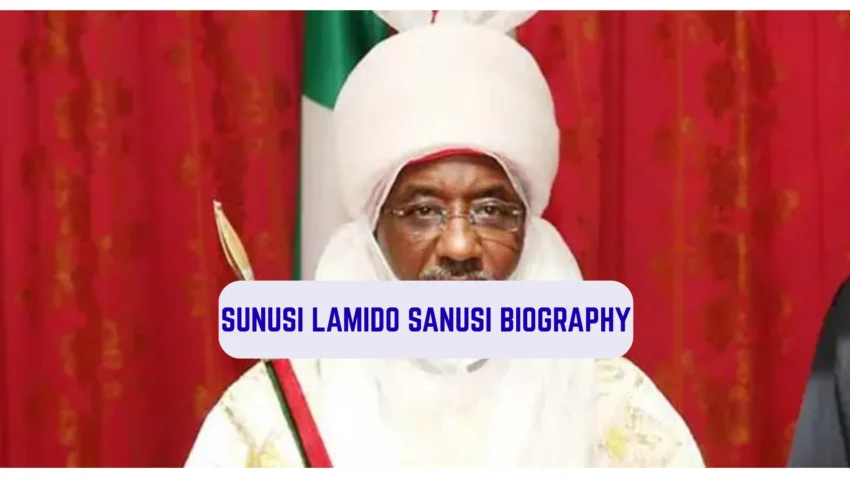
Sunusi Lamido Sanusi (also known as Muhammadu Sanusi II) is one of the most influential Nigerians of the 21st century — a reformer, scholar, banker, spiritual leader of the Tijaniyyah Sufi order, and Emir of Kano with a complex and compelling story that spans global finance, traditional leadership, and bold socio-political challenges.
Profile Data
- Full Name: Sunusi Lamido Sanusi
- Stage Name: Muhammadu Sanusi II
- Born: 31 July 1961
- Age: 64 years (as of 2025)
- Birthplace: Kano, Kano State, Nigeria
- State of Origin: Kano State
- Nationality: Nigerian
- Occupation: Traditional Ruler, Economist, Banker, Islamic Scholar
- Religion: Islam
- Parents: Aminu Sanusi (father)
- Spouse: Married
- Children: Has children
- Relationship: Married
Early Life & Royal Background
Born on 31 July 1961 in Kano, Northern Nigeria, Sunusi Lamido Sanusi comes from the esteemed Dabo dynasty — a Fulani royal lineage with deep historical roots in the ancient Kano Emirate.
His father, Prince Aminu Sanusi, was a distinguished diplomat and served as ambassador to several countries, including Belgium, China and Canada, giving Sunusi a blend of traditional royalty and global exposure from an early age.
Raised in the palace of his great-uncle, Emir Ado Bayero, Sanusi received both religious instruction (Qur’an, Hadith) and secular education, shaping his dual identity as an Islamic scholar and modern intellectual.
Education: East Meets West
Sanusi’s education is a powerful blend of Western economics and Islamic scholarship:
- St. Anne’s Catholic Primary School, Kaduna – Early foundational studies.
- King’s College, Lagos – Secondary education (Western African School Certificate).
- Ahmadu Bello University, Zaria – B.Sc. in Economics (1981) and M.Sc. in Economics (1983).
- International University of Africa, Khartoum, Sudan – Islamic Law & Arabic studies.
- Ph.D. in Islamic Law (2024) from SOAS, University of London — focusing on Islamic family law as a tool for social reform.
This unique educational fusion allowed him to navigate both Nigerian secular institutions and Islamic traditional structures with intellectual depth and credibility.
Professional Journey: From Banker to Central Bank Governor
Sanusi’s career began in the banking sector, where he rose rapidly due to his expertise in risk management and institutional integrity:
Banking Experience
- ICON Limited (Merchant Bankers): Early career in finance.
- United Bank for Africa (UBA): Credit & Risk Management, later General Manager.
- First Bank of Nigeria: Executive Director (Risk & Management), later Group Managing Director (CEO).
His leadership at First Bank marked him as a top financier in Africa before entering public service.
Governor, Central Bank of Nigeria (CBN): Banking Overhaul & Reforms
In June 2009, Sanusi was appointed Governor of the Central Bank of Nigeria (CBN), a role that propelled him into national prominence.
Major Reforms
Sanusi introduced sweeping reforms to stabilize Nigeria’s banking system during a global financial crisis:
- Commercial banks audit & recapitalization: Identified weak banks and restored health to the sector.
- Removal of executives: Replaced CEOs of troubled banks, emphasizing accountability.
- Asset Management Corporation of Nigeria (AMCON): Created to absorb toxic assets and prevent collapse.
- Promotion of electronic (cashless) policy and Islamic banking initiatives.
These reforms, often referred to as the “Sanusi Tsunami,” restored investor confidence and prevented systemic failure — but also earned powerful adversaries.
Major Controversy: The $20 Billion Oil Revenue Revelation
In 2014, Sanusi publicly accused the Nigerian National Petroleum Corporation and government officials of failing to account for approximately $20 billion in oil revenues — a revelation that shook national politics.
This confrontation with the federal government led to his suspension from the CBN by President Goodluck Jonathan — an event seen by many as politically motivated retaliation for his outspoken anti-corruption stance.
Emir of Kano: Tradition Meets Modern Advocacy
After his CBN tenure, Sanusi returned to his royal roots:
- Appointed Emir of Kano on 8 June 2014, succeeding Emir Ado Bayero.
- Became Khalifa (spiritual leader) of the Tijaniyyah Sufi Order, a major Islamic movement across West Africa with over 50 million adherents.
As Emir, Sanusi advocated for education, women’s empowerment, socio-economic reforms, and interpretation of Islamic law to meet modern realities.
His balanced approach to tradition and progressive thought often placed him at odds with conservative elements and state authorities alike.
Deposition, Exile & Reinstatement
In March 2020, Sanusi was deposed and exiled by the Kano State Government led by Governor Abdullahi Ganduje — a dramatic fall from the throne that sparked national debate about political overreach into traditional institutions.
After several years, his emirship was restored on 23 May 2024 by Kano State Governor Abba Kabir Yusuf through a repeal of prior laws that had fragmented the Emirate Council.
Influence Beyond Nigeria
Sanusi is widely recognized as a global thought leader:
- Speaker at international forums, including the World Economic Forum.
- Education advocate: Chairman of education initiatives and UN SDG supporter.
- Board roles: Independent Non-Executive Director at MTN Group and other institutions.
His voice spans economics, religion, governance, and societal reform.
FAQs
Q1: Who is Sunusi Lamido Sanusi?
He is a Nigerian royal, former CBN Governor, Emir of Kano, and spiritual leader of the Tijaniyyah Sufi Order.
Q2: What did he achieve at the Central Bank?
He stabilized the banking sector, introduced reforms, enhanced risk management, and increased transparency.
Q3: Why was he suspended from the CBN?
His suspension followed his public revelation of missing oil revenues and critiques of government fiscal management.
Q4: When did he become Emir of Kano?
He became Emir on 8 June 2014, was deposed in March 2020, and reinstated in May 2024.
Q5: What is his legacy?
Sanusi’s legacy blends financial reform, intellectual leadership, and courageous calls for accountability and socio-religious progress.
Conclusion
Sunusi Lamido Sanusi’s life story is a testament to fearless leadership across multiple spheres — financial reform, traditional rule, and moral authority. He remains a figure of immense complexity: admired as a reformer, debated as a public intellectual, and respected as a cultural bridge between tradition and modernity. His journey offers powerful lessons in resilience, courage, and the enduring impact of principled leadership.